
The Painting that Tormented Dostoevsky

In 1867, the Russian novelist Fyodor Dostoevsky left St. Petersburg and set off for Europe with his new bride. It wasn’t exactly a honeymoon, as Dostoevsky was mostly interested in escaping crippling financial debts brought about by the recent death of his brother and his penchant for the roulette table. And presumably picking the wrong numbers and colors at such table. In the midst of this turmoil, Dostoevsky was struggling to find spiritual renewal, or at least enough vitality to help him work through his next novel.
Dostoevsky had only recently finished Crime and Punishment (published in 1866) and was still developing a unique worldview situated at the intersection between the human will, with all its delusions, contradictions, and sinfulness on the one hand, and faith, righteousness, and God on the other. Dostoevsky was a devout Christian, but one that was not content with just the label. In his younger years, he spent four years in a penal colony in Siberia and witnessed and experienced degradations that brought his religious world view into hyper-focus. The only item he brought with him to Siberia was his copy of the New Testament.
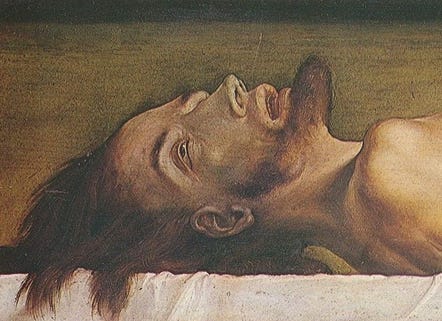
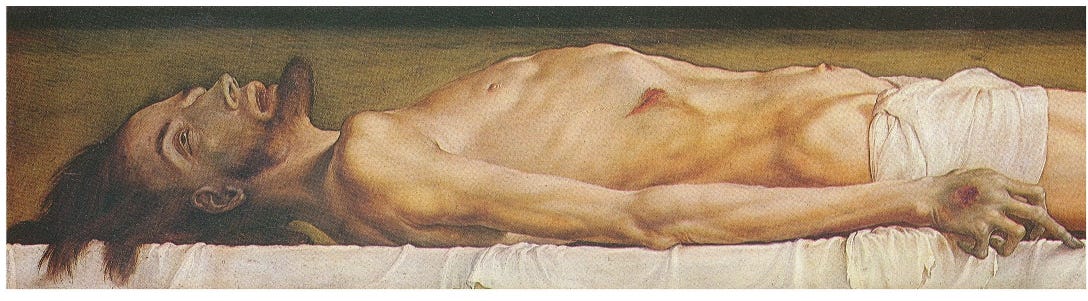
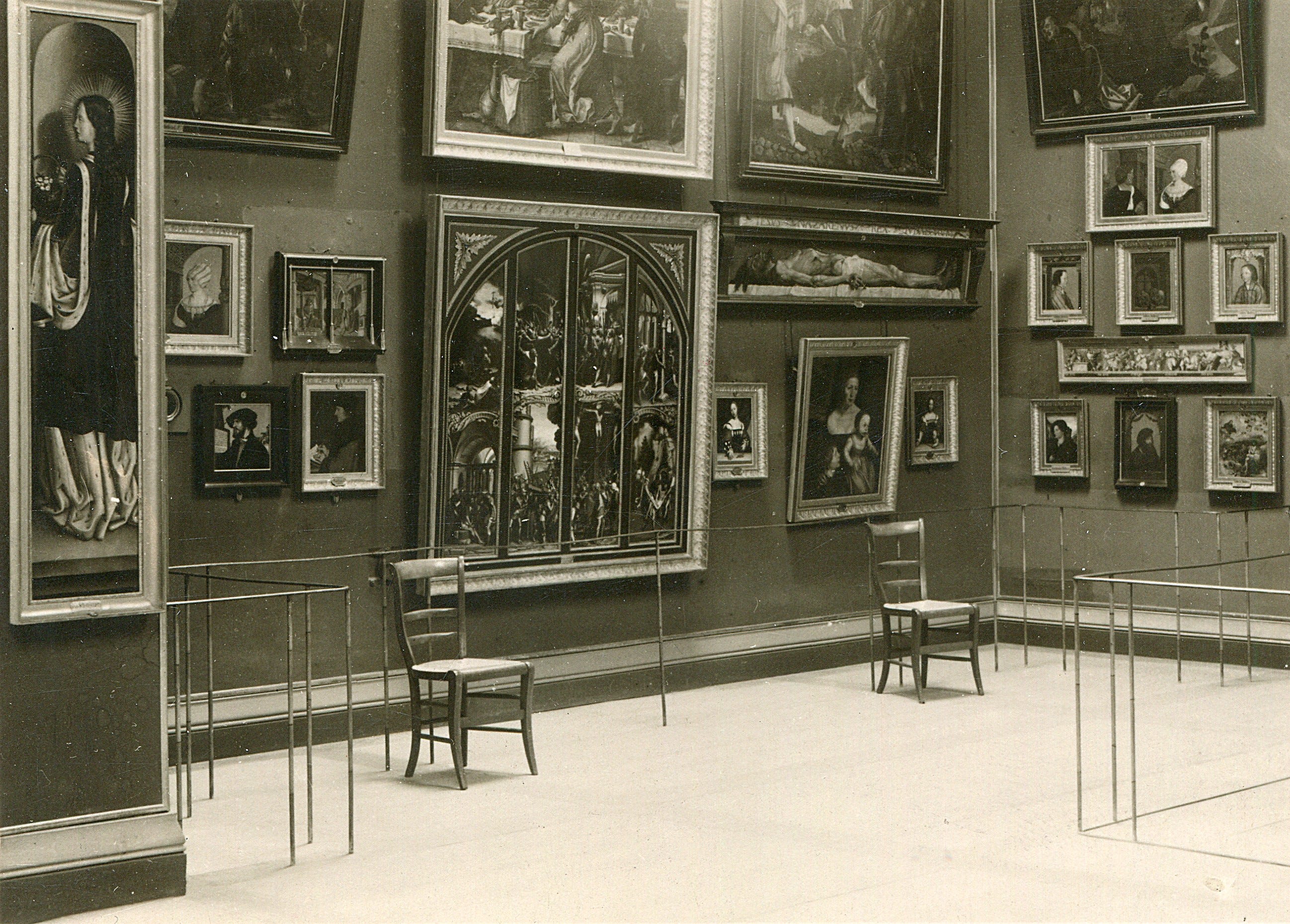
During this tumultuous European excursion, Dostoevsky found himself traveling through Basel, Switzerland, where he decided to visit the local art museum, the Kunstmuseum. While there, Dostoevsky became transfixed by one particular painting, The Body of the Dead Christ in the Tomb, by Hans Holbein the Younger, painted in 1521. The painting is alternatively referred to as the bleakly titled Dead Christ.
His wife Anna wrote about the visit in her diary:
“This painting by Hans Holbein depicts Christ who has endured inhuman torment, already taken down from the cross and decaying. His bloated face is covered with bloody wounds and his appearance is terrible. The painting had a crushing impact on Fyodor Mikhailovich. He stood before it as if stunned . . . When I came back after fifteen or twenty minutes, I found him still riveted to the same spot in front of the painting. His agitated face had a kind of dread in it, something I had noticed more than once during the first moments of an epileptic seizure. Quietly I took my husband by the arm, led him into another room and sat him down on a bench, expecting the attack from one minute to the next.”

Given the impression it made on the author, it is not surprising that Holbein’s painting makes an appearance in Dostoevsky’s next novel, The Idiot, which he wrote during this same European tour. He and his wife ended up spending four years there, which suggests they were moving very, very slowly. In the novel, a copy of the painting hangs in the gloomy apartment of Rogozhin, the godless would-be murderer. But it is another character, the young nihilist, Ippolit, an 18-year-old boy dying of consumption, who sees the painting and is transfixed by it. In his final “Explanation,” his intended suicide note, Ippolit expounds on its meaning.
“There was no hint of beauty in Rogozhin’s picture . . . the face is terribly mangled by blows, swollen, with terrible, swollen, bloody bruises, the eyes open and unfocused; the whites wide open, gleaming with a kind of deathly, glazed lustre. But it’s odd; as you look at this corpse of a tortured man, a most curious question comes to mind; if a corpse like that (and it must certainly have been exactly like that) was seen by all his disciples, his future chief apostles, and seen by the women who followed him and stood by the cross, by all in fact who believed in him and worshipped him, how could they have believed, looking at such a corpse, that the martyr would rise again?”
Ippolit’s impression of the painting mirrors that of Dostoevsky. The author was never shy about expressing his own personal torments through the mouths of his characters.
“The compulsion would be to think that if death was so dreadful, and nature’s laws so powerful, how could they possibly be overcome? How could they be overcome when even he had failed, he who had vanquished even nature during his lifetime, he whom nature had obeyed . . . Looking at that picture, one has the impression of nature as some enormous, implacable, dumb beast, or more precisely, strange as it may seem—in the guise of a vast modern machine which has pointlessly seized, dismembered, and devoured, in its blind and insensible fashion, a great and priceless being, a being worth all of nature and all her laws, worth the entire earth—which indeed was perhaps created solely to prepare for the advent of that being!” (Part III, Ch. 6)
The museum story shows how Dostoevsky in real life was like a character in a Dostoevsky novel – hypersensitive, brooding, and wired to take everything to its analytical extremes. In particular, Dostoevsky was compelled to subject his deepest religious convictions to intense examination and re-examination. This is the type of man who would test the effectiveness of a helmet by running headlong into a brick wall over and over.
Given these personality traits, Dostoevsky’s obsession with Dead Christ makes a lot of sense. It represents the absolute low point in the story of Jesus of Nazareth. It was the crisis moment – not for Jesus – but for his followers. For all like Dostoevsky who pursue belief over non-belief.
Ippolit’s analysis of the painting is piercing, but it ignores – intentionally – the elephant in the room. It leaves out the most important part of the story. It’s like turning off The Shawshank Redemption right before Andy Dufresne escapes from prison.
“Yeah, I’ve seen enough. I get it.”
“No, you don’t get it. I’m telling you – something important is going to happen!”
Starting from the scene featured in the Holbein painting and looking backward, the chronicle of the life of Jesus of Nazareth is a complex, multi-layered story of an influential religious teacher who was executed by crucifixion, a fate that Jesus predicted, then precipitated, then willingly endured. His teachings themselves, often told through parables and recorded by his adherents, contain immense wisdom, and provide an enduring set of principles for moral and spiritual development. But it is the story of Jesus of Nazareth – his life, death, and resurrection – that ultimately define Christianity.
Christian belief is not a static set of principles and conclusions, which is something non-Christians often have a hard time appreciating. Yes, over the course of the decades and centuries after the crucifixion, the early Church Fathers devised a written set of beliefs, but that was a systematization of his teachings and a chronicle of actual events. It’s not a mathematical theorem. It’s not even a philosophy. There’s a reason the New Testament is not presented as a philosophical treatise, winding towards proven and provable conclusions. The first four books of the New Testament, referred to as the Gospels, are four separate and largely independent accounts of the life of Jesus of Nazareth. They are stories, written like memoirs of first-hand accounts. Whether you regard their contents as true or not, the authors who wrote them fully intended that they be sold in the non-fiction section of the bookstore.
As each Gospel unfolds, Jesus incrementally reveals more and more of who he is and what he is seeking to accomplish. While many of his followers believed Jesus was there to serve a political purpose, to be the long-awaited Messiah, it becomes increasingly clear that the stakes are different, and significantly higher. Jesus makes many bold and strange statements about his mission, that he was not only sent from God, but that he is the Son of God, a manifestation of the divine himself. He tells his disciples that he will be crucified, but that he will rise again on the third day.
He sets off to the city of Jerusalem to fulfil this purpose, diving headlong into historical events. There he is arrested and, at the urging of the Jewish religious leaders, is tried before the Roman authorities, the only government with the power to execute someone in that particular place and time. Jesus stands before the local Roman prefect, Pontius Pilate. From the interaction between Jesus and Pilate, it is clear that Jesus holds his fate in his own hands. Pilate, like any bureaucrat worth his salt, just wants the problem to go away and pursues any and all means to avoid assuming personal responsibility for the matter at hand, ultimately allowing “the people” to decide Jesus’s fate. As the “Judgement of History” has made abundantly clear, Pilate’s gambit to avoid ownership of the decision to execute the Son of God backfired spectacularly. Ahh, human bureaucracy, the dumbest and most implacable of beasts.
Jesus is tortured and crucified. The Holbein painting captures the moment when all hope is lost. Jesus of Nazareth is dead, having already voluntarily committed his soul while on the cross. His body is now a corpse. This is not a religious heresy. This is what Christians believe. Jesus was a human being who was crucified. At this point, all but one of his disciples were scattered (his closest friend, John, remained to comfort Jesus’s mother Mary). In the chaos surrounding Jesus’s arrest, the boldest disciple of them all, Peter, withered and denied even knowing him. Thrice, actually. Even though Jesus literally told them several times that he would rise on the third day, at this moment there was no quiet confidence to be found among his followers.
After the crucifixion, Jesus was buried not by his disciples but by Joseph of Arimathea and Nicodemus, two respected men who were sympathetic to Jesus’s ministry and were now, for the first time, publicly associating themselves with him, albeit now in death. The Sabbath was approaching, so they quickly preserved the body with myrrh and wrapped it in linen. Given the late hour, the women would have to return after the Sabbath to finish the job.
Which takes us back to Dostoevsky, as Ippolit continues his meditations on Holbein’s painting. Here Dostoevsky dwells on the reality that even Jesus’s closest disciples, who had literally seen Jesus perform miracles, were in a state of hopeless despair as they realized their master was not immune to the inevitability of death.
“The people who surrounded the dead man, not one of whom is shown in the picture, must have felt a terrible anguish and confusion on that evening, which had shattered all their hopes and almost their entire belief at one fell blow. They must have dispersed in a state of dreadful fear, though each of them also carried away within him one mighty thought which could never now be wrested from them. And if the master himself, on the eve of his execution, could have seen this image, would he have mounted the cross as he did, and died as he did?”
Dostoevsky does not directly refute or even respond to Ippolit’s nihilism in The Idiot. The dramatic direction of the novel does not lend itself to the type of point and counterpoint analysis found in his other works. He had already done some of that work in Crime and Punishment and would raise his ambitions even higher in The Brothers Karamazov, both on the side of faith and on the side of its negation. By any measure Dostoevsky led a hard life, and each misfortune sent a ripple through, and added shape to, the dialectic that fuels Dostoevsky’s writing. These ills were partly self-imposed through profligate gambling and financial mismanagement, but he also lost several children, including his infant daughter Sonya while writing The Idiot, and suffered from debilitating epilepsy, which got progressively worse during that same period. Dostoevsky knew that no one is exempt from the struggle and indignities imposed by the “dumb, implacable beast” of nature and the “vast modern machine” of the world. The suffering might not be evenly allocated, but it is universal. For Dostoevsky, the only answer was to seek Christ.
Christians celebrate the Resurrection every year on Easter Sunday. In the Eastern Orthodox tradition, the church to which Dostoevsky belonged, the midnight church service on Easter, also known as Pascha, is something to behold. Among Christian denominations, the Orthodox have certainly intuited the significance of reliving the story of Christ and have unapologetically maintained the corresponding rituals across the centuries.
Each year, as the clock approaches midnight, all the people depart from the church building. The lights inside are turned off. Everyone outside holds an unlit candle. In the darkness, the priest takes a light from the vigil candle and emerges from the church. He transfers the flame to the candle of the closest parishioner, who passes that on to their neighbor, and so on and so forth until everyone’s candle is lit.
This dramatic prelude is leading up to the anticipated announcement, the cathartic statement that defines the Christian faith, “Christ is Risen!”, but in doing so, the priest first reads from the Gospel of Mark:
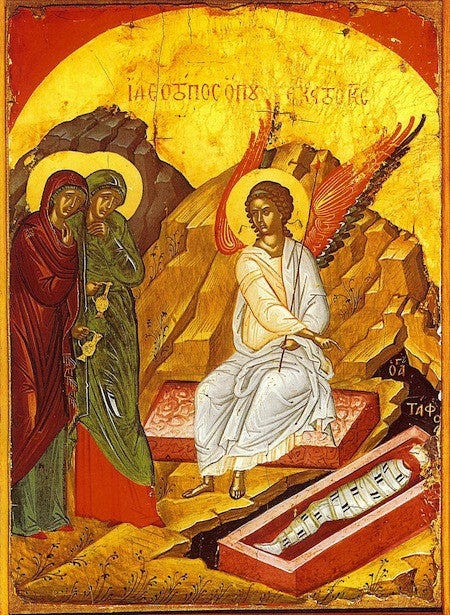
“Now when the Sabbath was past, Mary Magdalene, Mary the mother of James and Salome bought spices, that they might come and anoint Him. Very early in the morning, on the first day of the week, they came to the tomb when the sun had risen.
And they said among themselves, ‘Who will roll away the stone from the door of the tomb for us?’
But when they looked up, they saw that the stone had been rolled away—for it was very large.
And entering the tomb, they saw a young man clothed in a long white robe sitting on the right side; and they were alarmed.
But he said to them, ‘Do not be alarmed. You seek Jesus of Nazareth, who was crucified. He is risen! He is not here. See the place where they laid Him. But go, tell His disciples—and Peter—that He is going before you into Galilee; there you will see Him, as He said to you.’
So they went out quickly and fled from the tomb, for they trembled and were amazed. And they said nothing to anyone, for they were afraid.”
Each of the four Gospels report on the Resurrection, but they are not explicit as to what it is all supposed to mean. During his ministry, Jesus said many things that hinted at its cosmic significance, but when his followers learned that he had risen, they were still confused, doubtful, and frightened. The Resurrection is not just another miracle. It is a world-shattering occurrence. Whether we admit it or not, as imperfect moral beings searching our way through a corrupt and broken world, we all strive for spiritual and moral redemption. In Christianity, the Resurrection was necessary because only through experiencing death was Christ able to overcome death, which holds out the possibility and promise of freeing all of us – past, present, and future – from death’s iron grip, to reconcile man with God, and to redeem humanity.
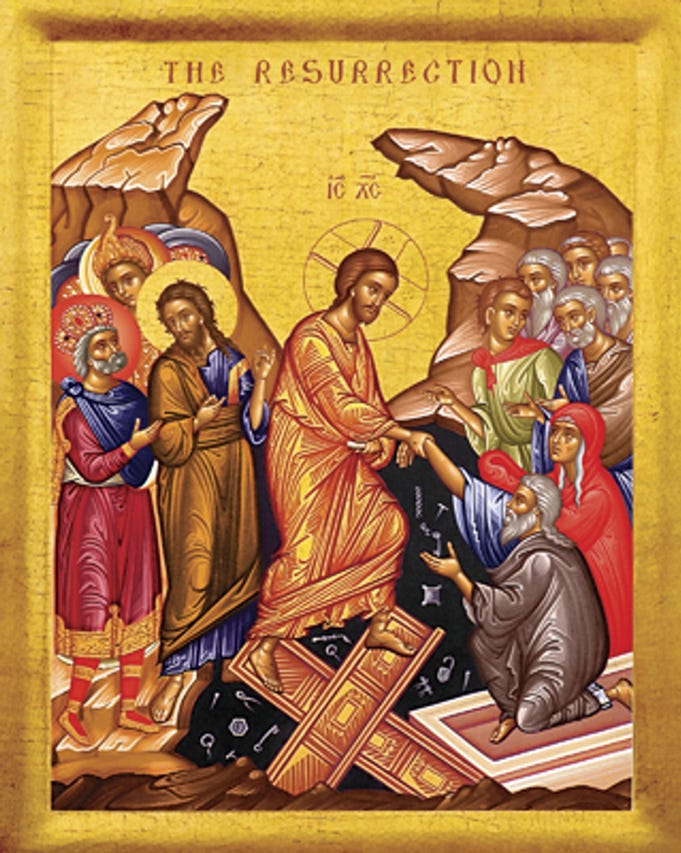
Don’t think the Resurrection is important? Guess who shows up in the icon. Adam and Eve!
Despite Ippolit’s provocations, Holbein’s Dead Christ does not capture the end of the story. There is a second act yet to come. For it is the Resurrection that carries the full narrative thrust of the Christian faith, evidencing the power of the divine to decisively defeat that dumb beast and modern machine that would otherwise devour everything and everyone in its path.
Dostoevsky, for all his internal torments, provides a sensible model for how to get on in this insensible world. That is, even if you can’t quite bring yourself to believe in the Resurrection, you should at least want to.
Love this and would love to reconnect! I am starting my own substack and I am kind of falling down the learning curve. I would love to pick your brain! My email is amy.gare@gare-law.com
Brian, I enjoyed that so thoroughly! Well done!